

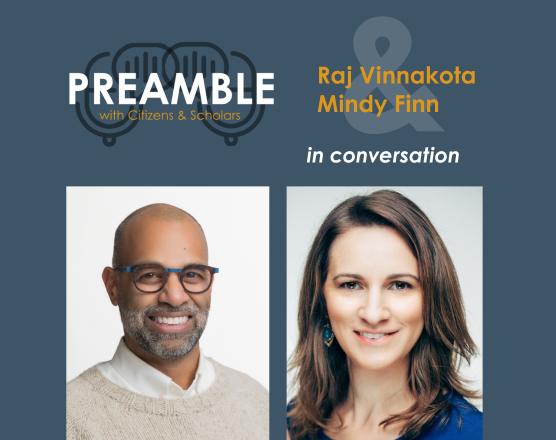
In this urgent moment for our nation, we can strengthen democracy—together. Raj Vinnakota, President of the Institute for Citizens & Scholars, sits down with diverse leaders to learn about their work and hear their ideas for shaping a more perfect Union. Here, Raj talks with Mindy Finn, Founder and CEO of Citizen Data. Below is an edited excerpt from the conversation recorded earlier in 2024.
Raj Vinnakota: You’re a civic entrepreneur who has worked at the intersection of tech and politics now for 20 years. Looking back on it, have there been significant moments or turning points for you along the way that really links all of your time to where you are now?
Mindy Finn: There’s a number of flashpoints across my career and life. I just always kind of had this deep sense of patriotism. I didn’t come from a particularly political family but had a next-door neighbor that we were very close with who was involved in campaigns, and I just really liked to tag along with them. I was invited to my very first election night return party for a local state legislative candidate and I was just mesmerized watching those returns. And I was very young. I was in fifth grade, and so fast forward to college times. The biggest flash point I would say probably in my entire career was September 11, 2001.
I was doing a journalism internship as part of my undergrad major, my kind of “study abroad” was in Washington D.C. I was a congressional correspondent for a mid-size newspaper in New England. My very first day on the job writing for the Waterbury Republican-American was 9/11. Wow. Suddenly, my first day on the job, I’m interviewing members of Congress as they were evacuating the Capitol. I was covering the whole aftermath of 9/11 and how Congress was responding and everything I wrote all semester pretty much was on the front page. I was kind of the most prized journalist for the paper because I was the one here covering it in Washington. That was my crash course on the impact and the importance of politics and policymaking on the lives of our citizens in our country. It taught me a couple of things. I liked the high adrenaline aspect of the work, and I wanted to be in public service, but I didn’t want to be a journalist. I wanted to be in the mix and making change happen instead of covering it. And that was the catapult to the rest of my career.
“My value system and what drives my work is the notion of representation in a democracy. That everyone’s voices are heard and that they have a role in the political process.”
Mindy Finn
Raj Vinnakota: We often talk, you and I, about the importance of restoring trust through representation in government. What are other ways we can restore trust in government?
Mindy Finn: I think having leaders with integrity – who are admirable and operate at a high level of ethics and with intent – even if they may have different ways of going about or different policy views – to actually have the public’s interest in mind as opposed to their personal interest. Other ways are having communications in media that is a source of trust, a source of faith. This is one of the hardest challenges and the most pervasive in our politics today. Across the board, the public, whether you’re Republican or Democrat, independent or otherwise, just feels like they lack the sources or the leaders that they can look to and trust. They’re really wanting that. Even those that are highly engaged and will spend time seeking it, they still feel like it’s lacking. And obviously, they’re also running up against just massive amounts of disinformation and misinformation and propaganda. So I think that’s really an area to focus on.
I think the other is that people are tending to sort themselves to live with people who are like them and then have a distrust of the “other”. There’s a lot of political division at the ground level. Based on our research, people might be feeling that on the whole there’s threats of political violence and discord, but the rank and file get along a lot better than even our leaders. In some cases, they’re able to solve problems together better. And so that’s important. It’s just being able to trust each other. We are aware of the problem, but the solutions have been more elusive than we want them to be, which is this lack of a sense of oneness and unity in our country. We’re all in this together, whether you’re red, blue, purple or otherwise. That has really been lost over the last couple of decades. And it’s what people like you and I and others in the pro-democracy community are trying to address.
Raj Vinnakota: We worked with Citizen Data to do a major national survey called The Civic Outlook of Young Adults in America. Is there anything from the research that you’ve done – either the studies you did with us or others – about Gen Z that you’re seeing that we should think about?
Mindy Finn: The risk that we have with Gen Z is they just are going to disengage from politics. They think they don’t fit in. There’s not really a place for them. They’ve written off the system in some ways, and yet there’s still a desire to be altruistic. There’s this sense that life could be better. We know where they’re spending their time – TikTok, YouTube, Instagram and the like. And we know that there are risks to engaging in a healthy way civically on those platforms, and yet they also present opportunities. You have to go where people are spending time. The real key is – and this is a challenge that we’re all working on – is increasing the level of civic knowledge…that saying that “knowledge is power”.
This is a generation that has a very low level of civic knowledge. We found only 18% of respondents had high levels of civic knowledge. You can’t always dispel disinformation like meet mistruth with truth and you’re going to solve the issue. But there is room to educate, and that education is powerful. We’ve found that if they had higher levels of civic knowledge that it will lead to greater faith and trust in the system.
Raj Vinnakota: Not only that, we also found a correlation with a decreased proclivity for violence. So that also feeds into this notion of trusting the environment and engaging civically.
Mindy Finn: Having the knowledge and trust creates a sense of security. When that security is there, one is less likely to want to turn to violence or unhealthy means to live out their angst.
Raj Vinnakota: Are you optimistic about our democracy?
Mindy Finn: Yes, I am optimistic about our democracy. I mean, I believe that our institutions are at great risk, they’re fragile. I think sometimes we can kind of undersell that. There probably needs to be more attention to that on balance. On the other hand, I have great faith in both the American people at large, as well as leaders who are stepping up to really protect and strengthen our democracy, both in the short and long term. I feel really grateful, like you, to be part of a broader ecosystem doing that work
“In my community, there was a debate over adding a play area to a green space in the neighborhood. It kind of sounds a little bit trite or silly given the bigger problems that we’re dealing with, but I actually don’t think these issues are. It was kind of a microcosm of how the democratic process works because the end result was a compromise.”
Mindy Finn
Raj Vinnakota: Can you share a time you actively engaged in your local community and what made that experience meaningful for you?
Mindy Finn: Yeah, absolutely. Well, this is a very niche issue. We forget engagement in politics is very local and there I think it can transcend all kinds of differences. In my community, there was a debate over adding a play area to a green space in the neighborhood. There was no kind of playground or play area. And this is a very fierce debate over several years with people that I would’ve otherwise been surprised were against it and other people being for it for various reasons. I participated both in signing petitions and filling out surveys related to it but also showing up at meetings to share my view on it. It kind of sounds a little bit trite or silly given the bigger problems that we’re dealing with, but I actually don’t think these issues are.
It was kind of a microcosm of how the democratic process works because the end result was a compromise. They moved forward, they made it smaller and took up a lesser footprint than maybe some people would’ve liked. So there would still be green space. People in the community are now going there more and meeting other neighbors and talking to neighbors of different backgrounds. In our virtual times, any opportunity to get people live and in person is contributing to a healthier civil society even in that small way. I have kids and they get to go play there which is something that means a lot to me personally.
Explore more Preamble